 1006
 Sep. 25, 2026
from Tengchong on the southwestern border of China to Bangkok, the central city of Southeast Asia, In September, the Tengchong Scientists Forum brought its first thematic event overseas, arriving in Bangkok, Thailand. For a scientific exchange platform founded in Yunnan with the mission of "Technology Leading the Future," this is not only going global, but also signifying that the forum is beginning to proactively enter regional discussions on scientific cooperation.
The Tengchong Scientists Forum was jointly initiated in 2022 by Academician Gu Binglin, former President of Tsinghua University; Xu Zhihong, former President of Peking University; and Rao Zihe, former President of Nankai University. from the very beginning, its positioning included the goal of building a technology cooperation platform between China and South Asia, and Southeast Asia; By the fifth anniversary in 2026, international cooperation will also be listed as a key focus for further development of the forum.
At a forum held in Bangkok, Academician Xu Zhihong was interviewed by Times Caizhi. This scientist, who once led one of China's top universities for a long time and later helped establish the Tengchong Scientist Forum, did not talk much about "international influence," but instead returned to a simple question: the problems faced by science require joint exploration.
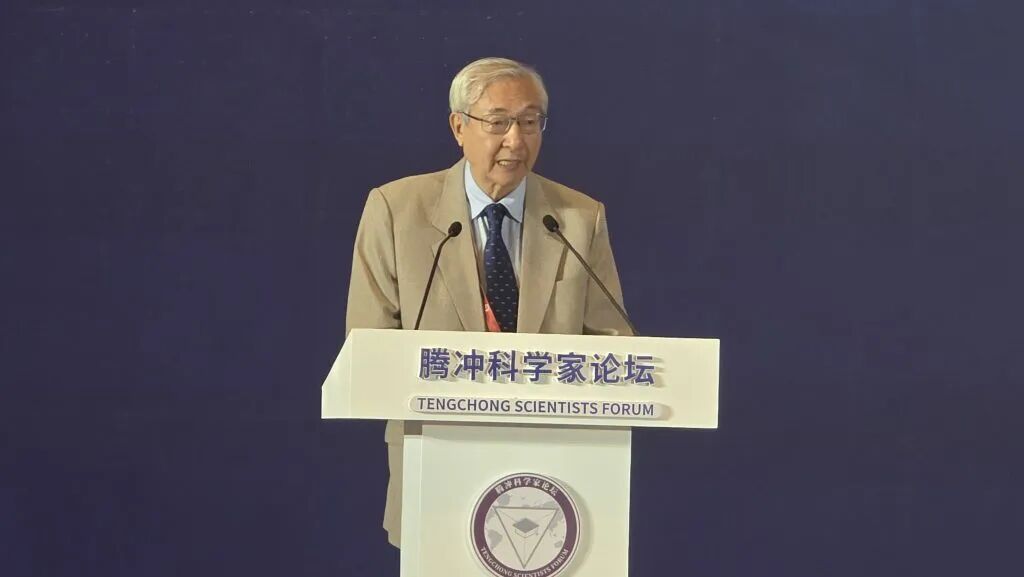
At the Tengchong Scientists Forum held in Bangkok on September 21, Academician Xu Zhihong spoke.
Bangkok, first overseas stop
Tengchong Forum first came to Thailand outside China, where Academician Xu Zhihong began by discussing his connection with Yunnan.
Yunnan is located in southwest China, adjacent to Southeast Asia, and has maintained close exchanges of people, education, and culture for a long time. In his view, starting from Yunnan and taking Southeast Asia as the first step toward internationalizing the forum is a natural choice. In the past, when he participated in international university exchanges as president of Peking University, he felt the long-standing ties between Southeast Asian and Chinese universities.
" There may be cultural and culinary differences, but Asian countries share many similarities. Academician Xu said in an interview. These foundations, formed through history, culture, and long-term exchanges, make it easier for China and ASEAN countries to sit down and discuss many issues, and to find common concerns.
At the event, multiple collaborations between universities and research were further promoted. Academician Xu regards these as the "first step," saying, "Regional cooperation does not have to start from scratch." China has a long-standing foundation for exchanges with Southeast Asian universities and research institutions, which can make these connections more sustainable and gradually form more substantive cooperation mechanisms. ”
If the Tengchong Forum in recent years has focused more on bringing scientists from around the world to Yunnan, then another signal from Bangkok is: Tengchong is also beginning to actively go global.
This kind of change is especially important on the fifth anniversary.
Xu Zhihong recalled that the forum's initial establishment was not easy. The first forum was still held during the pandemic period, but Yunnan ultimately insisted on promoting the forum's implementation. Since then, more and more academicians from the two academies, university presidents, scientists, and industry professionals have come to Tengchong each year, gradually forming its own influence. "This year marks the fifth anniversary, and we want to move on." he said.
"step out" is not simply transplanting one conference to another city, but answering a question: How can a scientific platform that has grown from a Chinese region find its place in scientific cooperation in Asia and even globally?
What Southwest Associated University left behind is a kind of spiritual
to understand the Tengchong Scientist Forum, you can't avoid the Southwest Associated University.
Over eighty years ago, amid the flames of the War of Resistance, Peking University, Tsinghua University, and Nankai University moved south and formed the Southwest Associated University in Yunnan. Under extremely harsh conditions, this university, which existed for just over eight years, has cultivated a group of outstanding talents who have influenced the development of science, education, and thought in China.
it is this period of history that reconnects the three old principals—Gu Binglin, Xu Zhihong, and Rao Zihe—with Yunnan.
Academician Xu Zhihong said that today's discussion about inheriting Southwest Associated University is not about "moving Peking University, Tsinghua University, and Nankai University back to Yunnan." Back then, students studied in rudimentary classrooms and, even facing the threat of war, still persisted in running the school; It was in such an environment that a group of outstanding scientists, including Yang Zhenning and Li Zhengdao, emerged.
" After such difficult circumstances, a large number of talents have been cultivated, and today we must uphold this spirit even more. ”
forum aims to inherit the ability of science and education to remain open, knowledge-seeking, and cooperative even when facing difficulties and uncertainties. This is even more realistic in the international context of 2026.
" Politics is the business of politicians. " he said. Issues involving national security are naturally more complex and inevitably influenced by political factors; However, humanity still has many common needs—from food, clothing, housing, and transportation to healthcare, from diseases to the environment. These issues will not disappear just because of national borders. This may also be the real fulcrum Tengchong Forum needs to find after expanding into Southeast Asia.
traditional medicine shifts from "knowing it is effective,"
direction "Know why it works"
At this Bangkok Forum, Academician Xu Zhihong specifically proposed a field he believes has a natural foundation for cooperation between China and ASEAN—ethnic medicine.
Academician Xu Zhihong himself is a plant biologist. When talking about ethnic medicine, this scientist in his eighties clearly entered his own field, speaking faster and continuously citing new examples.
China has Chinese herbal medicine, and many Southeast Asian countries also have a long tradition of herbal use. More importantly, Southwest China and Southeast Asia are precisely located in one of the regions with the highest biodiversity in the world. This means both sides not only possess traditional knowledge but also possess abundant biological resources worthy of modern scientific reassessment.
The question is, how does traditional experience enter the modern scientific system? Xu Zhihong believes that in the past, people might have known that a certain herb could "cure diseases," but today it remains only at the level of experience, which is no longer enough.
" We must use current science and technology to bring our national medicine to the forefront. " said Xu Zhihong. We should not only know that it can cure diseases, but also further study why it can cure diseases, to what extent it works, and improve the acquisition and production of active ingredients through modern technology. "Our tradition must be modernized."
He used artemisinin, ginseng, and others as examples to explain that the content of truly valuable active ingredients in some plants may be very low. Relying entirely on traditional cultivation and gathering requires a large amount of land and plant resources; Through modern biotechnology, cell culture, fermentation, and synthetic biology, humans may obtain these components in a more stable and efficient way in the future.
This is not only related to medicine, but also involves agriculture, ecology, biodiversity conservation, and industrialization. For Southwest China and Southeast Asia, which possess abundant plant resources and traditional medical knowledge, this could form a field of cooperation that is both historically rooted and technologically advanced.
Xu Zhihong even regards traditional medicinal knowledge as a kind of "clue" for modern science to find new drugs.
If you randomly search for medicinal substances from thousands of plant species in nature, it's like looking for a needle in a haystack; The medication experience accumulated over the past hundreds or even thousands of years has actually provided a directional map for today's scientific research.
tradition, here not the opposite of modern science. Tradition provides questions and clues, while modern science seeks evidence, mechanisms, and new modes of production. This is also what Xu Zhihong understands as "modernization."
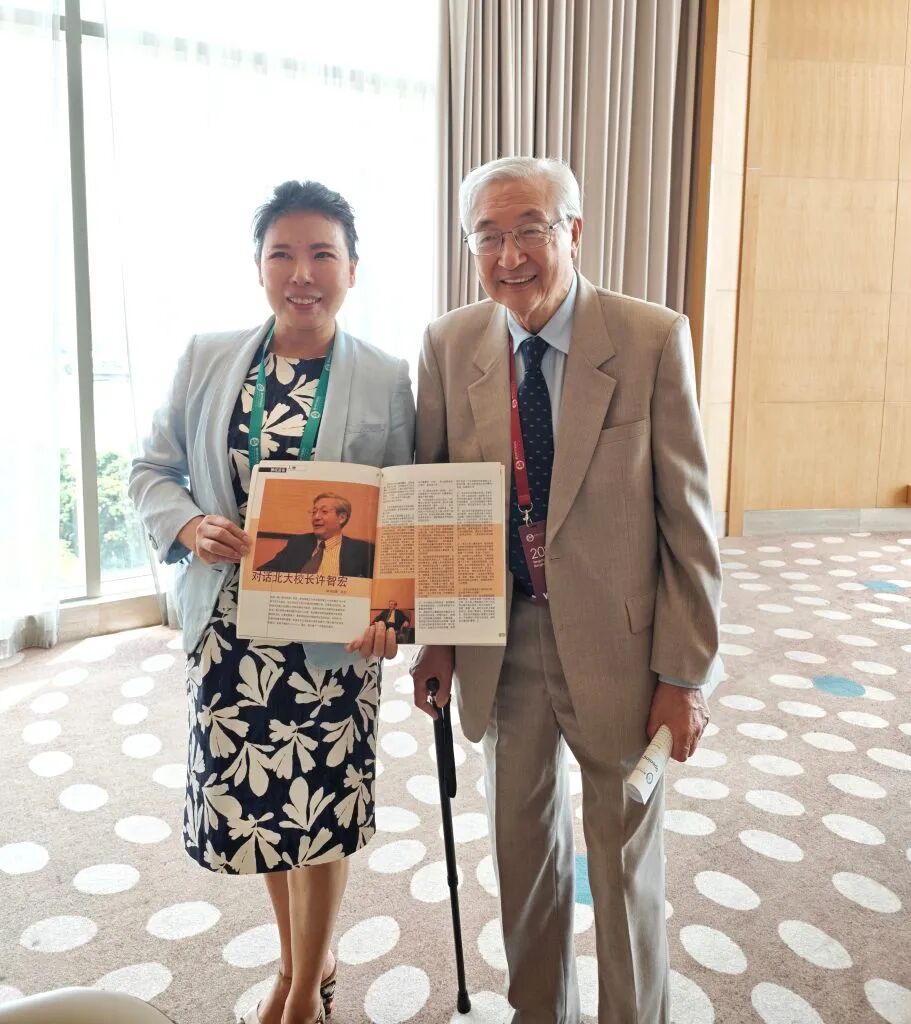
Times Caizhi Editor-in-Chief Song Wei was interviewed in Singapore in 2005 while serving as President Xu Zhihong of Peking University. Today, Professor Xu remains energetic and quick-witted, shouldering the heavy responsibility of scientific mission.
As the interview was coming to an end, he spoke about his relationship with Yunnan. As a biologist, he has always held a special affection for Yunnan's rich ecology and biodiversity. He admitted that as he has aged, his body is no longer as relaxed as before. This year, he even took a break for a while due to health reasons, but after recovering, he has resumed participating in activities and is still willing to go to Yunnan.
" We hope that through our efforts, we can help Yunnan develop better. What he was thinking about might not be where the forum will be next, but whether it can continue along this path—enabling universities, research institutions, and scientists from different countries to form long-term cooperation around truly shared issues, bringing scientific achievements from the conference venue into society, and giving new life to traditional knowledge from different civilizations in modern science.
In this sense, traveling from Tengchong to Bangkok is just the first step.
source: Times Financial Wisdom